
The key trends & concepts shaping B2B go-to-market thinking in 2026.
B2B marketing was once considered to be dry, rational, unimaginative, and just generally dull. ‘Boring-to-boring’. In 2026, that’s now changed.
Fundamental shifts in buying behaviour are combining with increasing empirical research, and fresh thinking on effectiveness, brand, and the optimum approach for driving revenue. As well, of course, as AI.
The result? A vibrant and dynamic field of study, and a number of key B2B trends, concepts and perspectives to keep a handle on.
Today’s go-to-market strategies need to account for all of the below. Does yours? If you need help thinking through the implications of these trends, and optimising your marketing and sales efforts, I can help.
AI is transforming marketing’s structure and function.
The ‘AI era’ is the biggest wave of change that marketing has ever faced, and will rapidly automate large parts of marketing execution.
Implications? We’re already seeing a structural shift in how marketing teams operate. Execution-heavy org charts are giving way to leaner, AI-enabled models, where smaller teams orchestrate agents, workflows and platforms at scale. This changes both roles and required skillsets. Less time is spent producing, and more time is spent designing systems, interpreting signals and making commercial decisions. Teams will need stronger strategy, clearer thinking and sharper insight. At the same time, new challenges emerge – from talent development, to managing cognitive load. The organisations that get ahead won’t be those using the most tools, but those redesigning how marketing actually works, and properly planning for change.


Only 5% of your market is actually in-market.
For any given B2B solution only about 5% of category buyers are actively in-market for a solution. The other 95% are out-of-market, and not seeking a vendor.
Implications? While the exact number will vary across categories, the lesson is pretty universal: even the most persuasive marketing/sales messaging will struggle to push an out-of-market buyer down a sales funnel! Instead, marketers should prioritize building brand: building favourable and relevant associations within the category, so our brand comes to mind when these buyers do enter the market. We also need to reconsider metrics (making sure we’re evaluating performance over the longer-term vs solely relying on immediate KPIs), our system design (so we’re properly detecting signals and intent), as well as rethinking the role that sales and marketing teams play throughout the entire buying process, particular for longer sales cycles.
Source: Ehrenberg-Bass Institute / LinkedIn B2B Institute.
90% of B2B buyers go with a vendor from their Day 1 Shortlist.
80% of buyers already know their shortlist of vendors before they even begin a purchase journey. And 90% will ultimately buy from that initial shortlist.
Implications? Even if the finishing line may be months in the future, brands may have already lost the race on day 1 of a buying journey… before they even know an opportunity exists! To win, businesses need to redirect marketing money towards always-on brand building activity that builds mental availability, and which runs across the entire buyer journey. This requires clever orchestration, an increasingly sophisticated tech stack, and a robust understanding of the buyer.
Source: Stein / 6Sense. Image: iStock


94% of B2B buyers use genAI as part of their buying process.
Nearly all business buyers report using AI during their buying process. This is efficient for buyers, but changes the way that brands need to orchestrate content.
Implications? Marketers need to architect their digital materials for consumption by AI, which means being purposeful not only about content and topic clusters, but also structure and tone, as well as technical on-page optimisation. The importance of a robust off-site strategy has also grown, meaning active PR, and placement of thought leadership content on high authority, expert third-party sites is vital to help influence AI-enabled decision making. And again, success metrics and leading indicators will change, with KPIs needing to extend well beyond website and keyword engagement.
Source: Forrester. Image: iStock
The number of people involved in B2B buying decisions is growing.
B2B solutions are bought by buying groups and committees, rarely by individuals. The number of people involved in these buying groups is increasing.
Implications? Marketing efforts need to cater to the needs of the entire buying group, to help create traction and enable deals to progress. LinkedIn calls this ‘Buyabilility’ – the sum of emotions that make up a buying group’s collective ‘confidence to buy’. Related, being able to chart and aggregate engagement and intent signals from multiple contacts within an account is important. Sales and account teams will also need to engage multiple contacts within accounts, and capture these into the CRM(!).
Source: LinkedIn / Forrester / Demandbase. Image: iStock


Understanding Category Entry Points is vital to enable growth.
Category Entry Points (CEPs) are the specific buying situations, triggers, or needs that cause buyers to enter a category and start considering solutions.
Implications? Understanding CEPs is crucial for marketers because it allows us to align marketing with the specific buying situations and triggers that lead to a purchase. If we can link our brand to these buying situations in buyers’ minds, it helps build mental availability – a much more relevant and buyer-centric objective than generic ‘brand awareness’. Crucial for getting on that Day 1 shortlist…
Source: Ehrenberg-Bass Institute / MiniMBA. Image: iStock
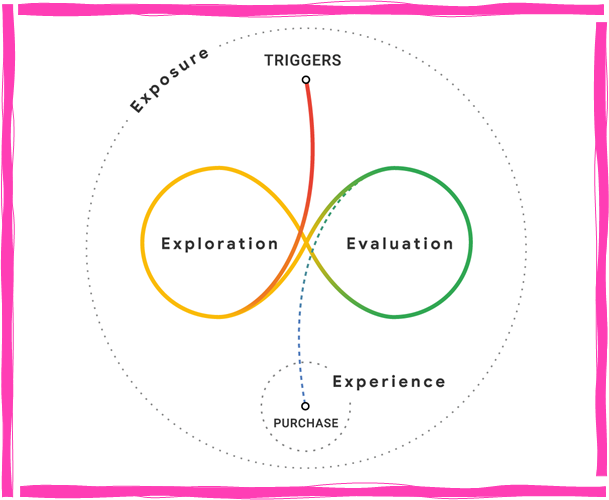
B2B buying journeys are not linear.
Although journeys are displayed as funnels or flow charts, this is a gross simplification: in reality, buyers flow between expansive exploration activity, and reductive evaluation activity – the so-called ‘messy middle’.
Implications? Marketing and sales need to orient around the buyer journey. Because buyers might move unpredictably, go‑to‑market strategy needs to shift from classic, stage‑based approaches to a more continuous, multi-channel model. Brand needs to be consistently presented whenever and wherever buyers re‑enter exploration or evaluation, while content should be designed to support buyers’ information needs – sense‑making, reassurance, internal justification. A non‑linear view of the journey also undermines any purely linear models of attribution, requiring a rethink there too.
Source: Think With Google.

84% of sales & marketing teams are misaligned on targeting.
The average overlap between B2B marketing and sales efforts is shockingly low. But when targeting does overlap, performance improves across every category.
Implications? Strong alignment often starts with marketing and sales teams refreshing ICP, segmentation and targeting criteria together: and, crucially, using real customer, and market data, rather than assumptions, quick anecdotes or legacy definitions. CRM adoption must also be treated as a commercial expectation, so target account lists and pipeline deals are visible, and can more easily be supported by marketing aircover.
Source: LinkedIn B2B Institute / Marketing Week. Image: iStock
The concept of the Marketing Qualified Lead (MQL) outdated.
Modern B2B marketing and sales teams are focusing on account-, opportunity-, and buying group-centred approaches, which are less myopic than MQLs.
Implications? System design needs to cater for making opportunities – with multiple contacts, and multiple engagement and buying signals – the hand-off point between marketing and sales, rather than individual MQLs. That means being able to track accounts, contacts, opportunities and engagement across systems – and therefore add important context and detail to digital signals being received – is vital. It also means that sales and marketing may need to revisit the definition of what ‘an opportunity’ even is, and how we track and nurture it through a pipeline process.
Source: Forrester / 6Sense. Image: iStock

What does this mean for your business?
If you need help thinking through the implications of these trends, and optimising your business’ marketing and sales efforts, let’s connect!